

The Engineering Behind the Modern Football Boot.
I've been playing since Class 4. Been through a fair few pairs over the years, different brands, whatever was in the budget at the time. Never really wondered why one felt lighter in my foot than another, or why one gripped the wet grass better and another didn't. They were just boots.
Then I started Design and Technology and got properly into mechanical engineering, and suddenly I couldn't unsee how much actually goes into them.
A modern boot isn't stitched leather anymore, not really. It's material science and biomechanics and aerodynamics and manufacturing tech, all crammed into something that weighs under 200 grams. Every stud, every curve, every layer of the thing is there for a reason, even the bits you'd never think twice about.
Weight is one of the first things engineers chase. A player can cover over 10 kilometres across ninety minutes. Every extra gram sitting on your foot costs you a bit more energy with every single stride. Doesn't sound like much on paper. Multiply that by thousands of steps and it stops being trivial.
That's basically a mechanical engineering problem at its core. Engineers are constantly testing polymers, synthetic fibres, composites, hunting for something flexible enough, tough enough, and light enough all at once. The boot has to survive sharp turns and hard shots and sudden direction changes without the player ever really noticing it's there.
The soleplate got me too, once I actually looked at it properly. Looks like a slab of plastic with studs stuck in it. It's actually one of the most engineered parts of the whole boot.
Stud shape, length, arrangement, all of it decides how well you grip the ground. Too much grip and your foot locks in place mid-turn, which is how ankles get wrecked. Too little and you're sliding everywhere. So engineers run through endless testing on grass, on turf, on wet surfaces, trying to land somewhere in between that actually works.
I'd felt this without ever knowing what it was. Some boots just felt planted during a sharp cut, others slid a bit more than I liked. Used to chalk it up to one pair being "better" than another. Turns out that was engineering the whole time, not luck.

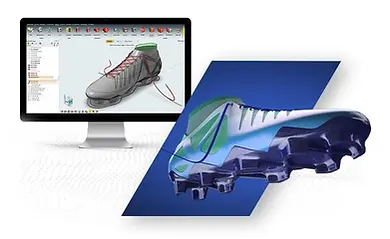
The upper's changed a lot too. Old leather boots were comfortable enough but soaked up water and got heavier as a match wore on. Synthetic uppers now stay light in any weather and give better control on the ball. Some engineers even study the surface texture itself, trying to improve the friction between boot and ball so players get more spin, more accuracy on a pass or a shot.
Design's mostly gone digital as well. CAD models every part before it's built, and simulations check stress and bending and deformation long before a physical boot exists.
I find that side of it genuinely interesting, given I do a fair bit of CAD myself. Whether it's a workshop tool organiser or an actual football boot, a lot of the process looks the same underneath. Find the problem, throw around some ideas, model it, test it, fix what's broken, repeat until it works properly.
There's 3D scanning now too, capturing the exact shape of a player's foot, paired with 3D printing to make insoles and components built for one specific person. Instead of everyone squeezing into the same shape, you get something matched to how you actually move.
AI's starting to show up in this as well. Movement data from professional players gets analysed to find pressure points, study running patterns, tune a boot for a particular playing style. A winger chasing speed probably wants something different from a defender who needs to hold their ground.
None of this is visible from the stands, which is the part I find most interesting. Fans see the goals and the skill and the celebrations. Behind every sprint and every tackle is a product that's been through years of testing and redesign that nobody in the crowd will ever think about.
Looking back, I used boots for years without giving any of this a second thought. Studying engineering's changed how I look at basically everything now, not just boots. I don't ask "how does this look" anymore. I ask why it's built the way it is, and whether it could be built better.
That's probably the biggest shift engineering's caused in how I think generally. Even something as ordinary as a football boot turns out to be hundreds of small decisions and rounds of testing stacked on top of each other.
Next time I'm lacing up before a match, I'll still be thinking about the game, obviously. But somewhere in the back of my head I'll also be thinking about whoever spent years making those ninety minutes just slightly faster and lighter than they used to be.